
- csi_security
Types of Alarm Systems in 2025 and How to Choose the Right One
The landscape of alarm systems in 2025 has evolved beyond basic fire detection. Modern systems now integrate fire, intrusion, environmental hazard, medical alert, and access control functions, delivering unified protection across diverse building environments.
Driven by advancements in AI-based detection, cloud-based platforms, and real-time data analytics, today’s alarm solutions offer more accuracy, fewer false alarms, and seamless integration with building automation systems.
Choosing the right alarm system depends on the specific threats a property faces, ranging from smoke and carbon monoxide to unauthorized access, flooding, or medical emergencies.
Did you know? According to the National Fire Protection Association (NFPA), buildings equipped with modern fire alarm systems experience a 50% reduction in fire-related fatalities compared to those without such systems. |
This article explores each type of alarm system available in 2025, and guides you to choose the right type of alarm system, based on your specific needs.
1. Fire Alarm Systems
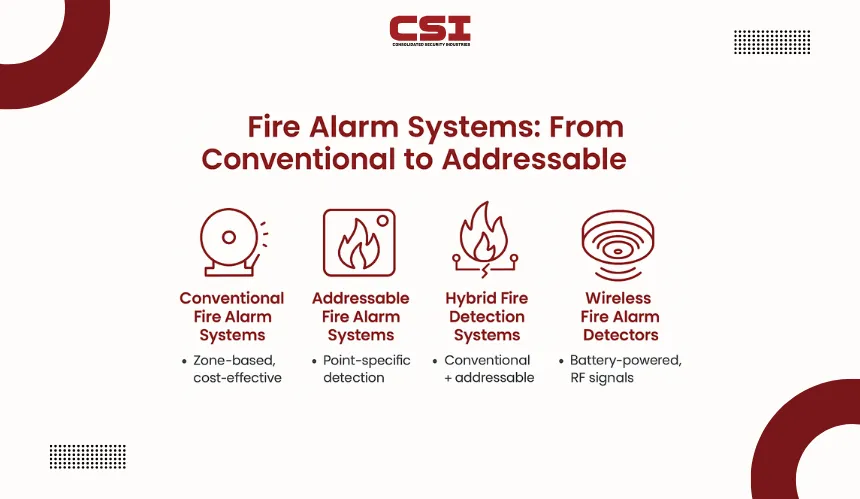
Fire alarm detectors remain the cornerstone of fire protection and life safety in both residential and commercial settings. In 2025, these systems have advanced to include intelligent detection technologies, real-time alerting, and seamless integration with fire suppression systems and building management systems.
The four primary types used today are conventional, addressable, hybrid, and wireless, each with unique technical characteristics suited for different building profiles.
a. Conventional Fire Alarm Systems
Conventional systems divide a building into detection zones, where multiple initiating devices, such as smoke and heat detectors and manual pull stations, are wired in parallel to a centralized Fire Alarm Control Panel (FACP).
When an alarm is triggered, the panel identifies the zone but not the exact device.
What are the benefits of conventional fire alarm devices?
- Cost-effective for small buildings with fewer zones
- Straightforward installation and maintenance
- Compliant with basic NFPA 72 requirements
Based on modern trends, the applications of conventional fire alarm systems are limited. They can be used in residential and commercial buildings, standalone retail stores, and low-risk occupancy structures. They have some limitations based on modern security needs:
- No point-level detection
- Limited scalability and diagnostic data
- Not compatible with cloud-based or smart integrations
b. Addressable Fire Alarm Systems
In an addressable fire alarm system, each device, including a smoke detector, a heat sensor, or a manual pull station, is assigned a unique address.
Devices communicate digitally with the fire alarm control unit (FACP), which pinpoints the exact device status and location in real-time. This system supports event logging, self-diagnostics, and remote programming.
What are the pros of addressable fire detectors?
- High-resolution device monitoring and pinpoint alerting
- Reduced wiring complexity using a single communication loop
- Enhanced troubleshooting, real-time diagnostics, and programmable logic
Addressable fire alarm systems have the capability to fulfill the modern fire monitoring requirements. They have room for advancements, including:
- Integration with AI-driven false alarm filtering and notification appliances
- Smart sensor calibration with environmental compensation
- Compatibility with BACnet and Building Management Systems (BMS)
- Cloud dashboards for remote access and compliance reporting
Addressable fire alarm systems have a lot of applications, considering the current security needs. They are best used in hospitals, high-rise buildings, industrial facilities, and data centers.
c. Hybrid Fire Detection Systems
Hybrid systems combine both conventional zone-based and addressable device logic, allowing legacy buildings to incrementally upgrade without complete system replacement. These systems typically support mixed communication protocols and are ideal for retrofit scenarios.
What are the advantages of hybrid fire alarm systems over traditional systems?
- Flexible and scalable across new and existing infrastructure
- Reduces cost in phased upgrade projects
- Simplifies migration to fully addressable systems over time
Hybrid fire alarm systems are crucial in 2025 for facilities seeking compliance with updated NFPA and UL standards without overhauling existing infrastructure. The main applications of hybrid fire alarm systems include:
- Retrofit compliance with updated NFPA 72 and UL 268 standards
- Partial cloud connectivity for remote diagnostics and logging
- Compatible with older wiring layouts and control hardware
Hybrid fire alarm systems are ideal to be used in schools, government buildings, legacy healthcare facilities, and campuses undergoing phased modernization.
d. Wireless Fire Alarm Detectors
Wireless systems use encrypted RF signals or mesh network communication to link detectors and modules to a central control unit. Each device is battery-powered and transmits real-time data without the need for extensive wiring.
What are the modern features of wireless fire alarm systems?
- AES-128 encryption for secure communication
- 10+ year lithium battery life with smart battery status alerts
- Dual-path communication (RF + cellular/IP) for signal reliability
- Mesh networking enables auto-routing and signal redundancy
Wireless fire alarm systems are not as reliable and functional as hybrid fire alarm systems. They have some limitations, including:
- Susceptible to radio interference if not properly commissioned
- Higher initial cost compared to wired solutions
- Requires routine battery and signal strength monitoring
They are best used in areas where it is not possible to make a lot of modifications in the building structure, including historical buildings, modular constructions, temporary setups, and leased facilities where wired infrastructure is impractical.
2. Intrusion & Burglar Alarm Systems
Intrusion alarm systems are designed to detect and deter unauthorized entry through doors, windows, or perimeters.
In 2025, these systems have advanced with AI-driven verification, real-time cloud alerts, and seamless integration with video surveillance, access control, and emergency communication platforms.
Whether for homes, retail stores, or critical infrastructure, intrusion systems form the first line of defense against break-ins and vandalism. They are divided into four main categories defined below:
a. Wired Intrusion Alarm Systems
Wired intrusion systems use physical cabling to connect motion sensors, door/window contacts, glass-break detectors, and keypads to a central control panel. They are typically hardwired into the building’s infrastructure and offer high reliability.
What are the advantages of wired intrusion alarm systems?
- Stable and interference-free signal transmission
- Ideal for new construction and long-term occupancy
- Compatible with most commercial-grade sensors and panels
They have some limitations, considering the modern security requirements including:
- Requires professional installation with routing through walls
- Less flexible for future reconfiguration or expansion
They are best used in banks, warehouses, large commercial buildings, and data centers.
b. Wireless Intrusion Alarm Systems
Wireless systems connect sensors to a control hub via encrypted RF, Wi-Fi, or mesh communication protocols. Devices are battery-powered, easy to install, and typically support mobile app control.
What key features do wireless intrusion alarm systems offer?
- AES-128 encryption with frequency hopping
- Dual-path communication (cellular + IP) for redundancy
- Mobile alerts with image/video verification from connected cameras
- Integration with smart locks, lighting, and intercoms
What are the advantages of these systems over other alarm systems?
- Flexible placement with no structural modifications
- Easy scalability and remote system management
- Rapid installation in leased or modular spaces
Based on real-life scenarios, they come with a few limitations, including:
- Signal interference risk in dense environments
- Battery life monitoring is required
The best facilities to use wireless intrusion alarm systems are retail stores, residential buildings, co-working spaces, short-term rentals.
c. Perimeter Intrusion Detection Systems (PIDS)
PIDS use advanced technologies, such as infrared beams, pressure sensors, vibration detectors, and buried cable systems, to monitor external boundaries like fences, gates, or building exteriors.
Key Technologies premier intrusion detection systems offer in 2025:
- Microwave and laser-based detection for precise perimeter control
- Seismic sensors for ground vibrations
- Fence-mounted accelerometers for intrusion impact analysis
- Thermal and infrared imaging for night-time protection
What are the main advantages of premier intrusion detection systems?
- Early detection before intruders enter the building
- Integration with CCTV, lighting, and audio deterrents
- Scalable across complex perimeters with zone isolation
What are the limitations of premier intrusion detection systems?
- Higher cost due to specialized hardware
- Requires professional design and calibration
These systems are best used in airports, industrial compounds, government facilities, and utility substations.
AI & Cloud Integration in 2025 Intrusion Systems
Modern intrusion systems leverage AI to reduce false alarms and improve detection accuracy. Cloud-connected platforms enable remote access, incident tracking, and real-time coordination with law enforcement or monitoring services.
Modern Enhancements:
- Object recognition to distinguish humans from animals or vehicles
- Smart video verification with facial detection
- Mobile push notifications and two-way audio response
- Integration with access control, lighting, and fire alarms for unified threat response
3. Environmental Hazard Detection Systems
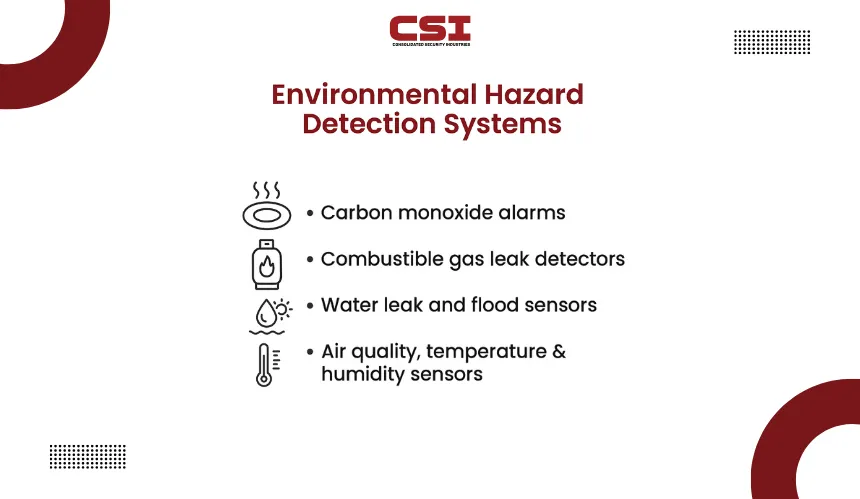
Environmental hazard detection systems monitor life-threatening conditions unrelated to fire or intrusion, such as carbon monoxide leaks, gas exposure, flooding, and poor air quality.
In 2025, these systems are more intelligent and networked than ever, using IoT-enabled sensors and predictive analytics to deliver early warnings before minor hazards escalate into major emergencies.
These systems are often integrated with building management systems (BMS), smart HVAC units, and central alarm panels.
They are critical in environments such as commercial kitchens, laboratories, industrial plants, basements, and multi-residential buildings, where unseen dangers can arise suddenly and spread silently. They are divided into four primary categories based on their functions, defined below:
a. Carbon Monoxide Detectors
CO detectors sense the presence of carbon monoxide gas, a colorless and odorless byproduct of incomplete combustion. Using electrochemical sensors, they issue audible and/or remote alerts when CO levels exceed safety thresholds.
What are the key features CO detectors offer in 2025?
- Real-time digital CO concentration display (ppm)
- Integration with HVAC systems for automatic ventilation
- Dual-purpose CO/Smoke combo detectors
- Smart app notifications and voice assistant compatibility
Their ideal applications are homes with gas appliances, hotels, underground parking, restaurants, and boiler rooms.
b. Combustible Gas Leak Detectors (Methane, Propane, Natural Gas)
These detectors monitor flammable gas concentrations and trigger alerts when levels approach the lower explosive limit (LEL). Modern detectors use catalytic beads or infrared sensors and often include automatic gas shutoff capabilities.
What are the modern enhancements made to combustible gas leak detectors?
- Multi-gas detection in a single unit (methane, butane, propane)
- Wireless communication with control panels or smart hubs
- Interfacing with emergency shut-off valves or suppression systems
- Compliance with UL 1484 and EN 50194 standards
They give the best safety results in commercial kitchens, industrial zones, fuel storage areas, and utility corridors.
c. Water Leak and Flood Detectors
Leak sensors detect water accumulation in areas prone to plumbing failures, HVAC overflows, or ground seepage. Devices use metal contact probes or rope-style moisture sensors to trigger alarms or initiate water shutoff protocols.
Key Features in 2025:
- Rope sensors for wide-area detection (e.g., data centers)
- Temperature + moisture sensing to detect freezing pipe risk
- Integration with smart valves for automatic water shutoff
- Remote alerting via cloud and app interfaces
They enhance the security features of your facility and are best to be usd in server rooms, basements, residential bathrooms, high-rise mechanical floors.
d. Air Quality, Temperature & Humidity Sensors
Environmental sensors track air quality metrics such as volatile organic compounds (VOCs), fixed temperature detectors, and humidity levels. In commercial buildings, these are tied to HVAC optimization and safety thresholds.
Emerging Capabilities in 2025:
- PM2.5/PM10 particle sensing for airborne risk detection
- Smart HVAC activation based on preset AQI limits
- IAQ (Indoor Air Quality) scoring for health compliance
- Integration with wellness platforms in smart buildings
Their ideal applications are healthcare facilities, schools, cleanrooms, LEED-certified buildings, senior care homes.
4. Medical Alert & Panic Alarm Systems
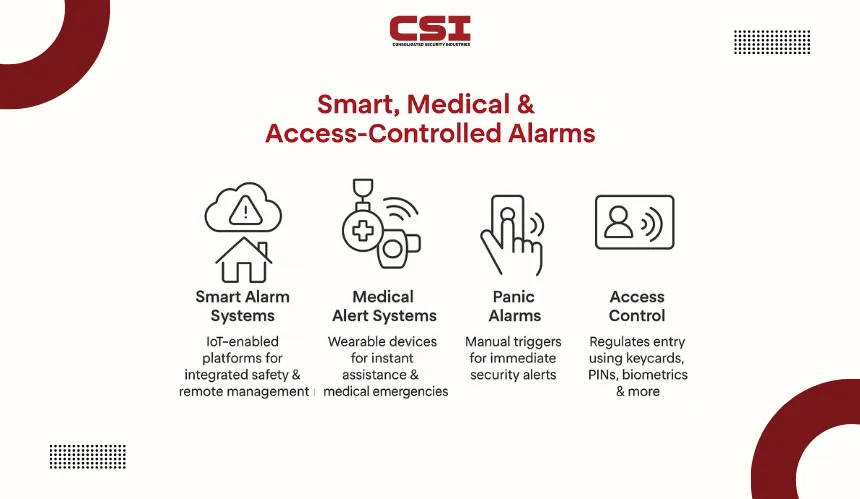
Medical alert and panic alarm systems provide immediate response capabilities in personal or workplace emergencies.
Unlike fire or intrusion systems, these are designed for rapid activation by the user in case of distress, medical, security, or otherwise.
In 2025, these systems are integrated into smart building infrastructure, wearable devices, and mobile platforms for 24/7 coverage. Their two main categories are described below:
a. Medical Alert Systems
Medical alert systems typically involve wearable buttons (wristbands, pendants) or fixed units. When activated, the system sends an instant alert to emergency responders, caregivers, or monitoring centers via cellular or IP networks.
Key modern capabilities they offer:
- Includes fall-detection sensors that automatically trigger alerts
- Offers GPS-enabled wearables for tracking users indoors and outdoors
- Provides two-way voice communication with monitoring professionals
- Syncs with health management apps and electronic medical records
They are used for elderly residents, patients with chronic conditions, assisted living centers, and home care environments.
| Did you know? The use of wearable medical alert devices has surged, especially among seniors; in 2024, over 30% of adults aged 65+ in the US used some form of personal emergency response system. |
b. Panic Alarm Systems
Panic alarms are silent or audible alarms activated via wall-mounted buttons, key fobs, or apps. These are often installed in high-risk zones and transmit alerts to on-site security or local authorities.
2025 Enhancements:
- Supports mobile-based panic triggers with location tagging
- Interfaces with access control systems to initiate automatic lockdowns
- Automatically activates CCTV cameras and alert lighting in affected areas
- Sends real-time alerts to local law enforcement or private response networks
They have applications in offices, banks, courthouses, hospitals, schools, taxis, and public spaces.
5. Access Control and Integrated Alarm Systems
Access control systems regulate who can enter or exit a facility and when, often forming the backbone of modern security systems.
In 2025, access control is no longer a standalone system; it is part of a fully integrated alarm and monitoring platform, combining identity management with real-time threat response. Their two main categories, based on their functions, are explained below:
a. Electronic Access Control Systems
These systems authenticate users via keycards, PINs, biometrics (fingerprint, facial recognition), or mobile credentials. Access logs are recorded and monitored via centralized software, with real-time integration into intrusion and surveillance systems.
2025 Enhancements:
- Supports biometric authentication, including facial recognition and fingerprint scanning
- Enables contactless mobile access via NFC or Bluetooth-based credentials
- Integrates with alarm systems to trigger door locking or unlocking during emergencies
- Offers real-time remote access management through centralized dashboards
Ideal Applications: Corporate campuses, government buildings, schools, industrial sites, and data centers.
b. Integrated Alarm Platforms
Integrated systems connect fire, intrusion, medical, access control, surveillance, and environmental monitoring into one centralized interface. These platforms allow security teams to manage alerts, camera feeds, access logs, and HVAC controls through a unified dashboard.
Key Capabilities in 2025:
- Provides unified dashboards to control and monitor all connected systems
- Uses AI to correlate events (e.g., intrusion + fire + access breach) and reduce false positives
- Supports cloud-based command centers for remote control and diagnostics
- Complies with enterprise communication standards such as ONVIF, BACnet, and UL 864
The best places to use an integrated alarm platform are smart buildings, schools, manufacturing plants, multi-site businesses, and mission-critical facilities.
6. Smart Alarm Systems (IoT-Enabled Platforms)
Smart alarm systems leverage the Internet of Things (IoT), artificial intelligence, and cloud platforms to provide proactive, real-time safety and security. These systems don’t just detect, they analyze, adapt, and respond based on context and behavior.
Smart systems connect all alarm components, fire, intrusion, gas, environmental, medical, and access, via cloud-based software and mobile apps. AI algorithms filter alerts, detect anomalies, and allow remote management from anywhere in the world.
Standout Features in 2025:
- Combines multi-sensor inputs such as smoke, gas, temperature, and occupancy to improve detection accuracy
- Uses AI-powered filtering to reduce false alarms and learn occupant behavior
- Supports smart home and building automation integration (e.g., Alexa, Google Assistant, HomeKit)
- Delivers location-based push notifications to users and responders across platforms
They are ideal to be used in residential smart homes, tech-integrated office spaces, mixed-use developments, and LEED-certified buildings.
Benefits of Smart Alarm Platforms:
- Unified control over all systems from a smartphone or dashboard
- Real-time notifications, status reports, and incident logs
- Reduced false alarms and improved response accuracy
- Scalable and adaptable to evolving safety protocols
How to Pick the Right Alarm System for Your Property
The best alarm system isn’t one-size-fits-all. It depends on your facility’s size, risk exposure, and operational needs. Below are three main things you should consider before choosing the right alarm system:
- Risk Profile: High-risk environments like hospitals or labs need medical alerts and gas leak detection, while retail stores may prioritize intrusion alarms and panic buttons.
- Infrastructure: Older buildings may require hybrid systems for compatibility, while modern or leased spaces benefit from wireless setups.
- Compliance Needs: Facilities subject to NFPA, UL, or healthcare regulations must choose systems that meet industry-specific safety codes.
Still confused about how to choose the right alarm system for the safety of your property? At CSI Security, we specialize in installing tailored alarm systems for commercial and residential properties. Our experts help you choose the right solution, code-compliant, scalable, and built for your building’s exact needs.
Frequently Asked Questions (FAQs)
Can smart alarm systems function during power or internet outages?
Many modern alarm systems are equipped with built-in battery backups that keep the system operational during power failures.
Additionally, modern systems often use cellular networks as a failover if the internet goes down, ensuring continuous communication with monitoring centers or mobile apps.
How do I prevent false alarms in my alarm system?
False alarms are often caused by incorrect sensor placement, environmental factors like pets or dust, or user error. Regular system maintenance, such as cleaning sensors and adjusting sensitivity settings, combined with thorough user training, helps minimize false triggers.
Investing in AI-enabled alarm systems that distinguish between real threats and harmless events can also reduce nuisance alarms.
Are there alarm systems specifically designed for renters?
Yes, many wireless and DIY alarm systems cater specifically to renters who cannot make permanent modifications.
These systems are typically easy to install and uninstall, use adhesive mounts instead of drilling, and offer flexible subscription plans. This allows renters to enjoy robust security without risking their security deposit or violating lease agreements.
How can I integrate my alarm system with other smart home devices?
Most contemporary alarm systems support integration with popular smart home platforms like Amazon Alexa, Google Assistant, and Apple HomeKit.
This interoperability allows you to control alarms through voice commands, automate actions based on sensor triggers, and create scenes that combine security with lighting, climate control, and more, delivering enhanced convenience and smarter safety.
How often should I test and maintain my alarm system?
To ensure reliability, it’s best to test your alarm system monthly by triggering sensors and confirming notifications.
Comprehensive maintenance, including battery replacement, sensor calibration, and firmware updates, should be done at least twice a year. Regular upkeep prevents malfunctions, extends system life, and keeps your protection up to date with evolving threats.
Can I control my alarm system remotely?
Yes, most modern alarm systems come with mobile apps that allow you to arm or disarm your system, receive real-time alerts, view live camera feeds, and even control smart devices remotely. This remote access offers enhanced flexibility and peace of mind, especially when you’re away from your property or managing multiple locations.