
- csi_security
What Is a Hybrid Fire Alarm System? Components, Benefits, Costs & Ideal Use Cases
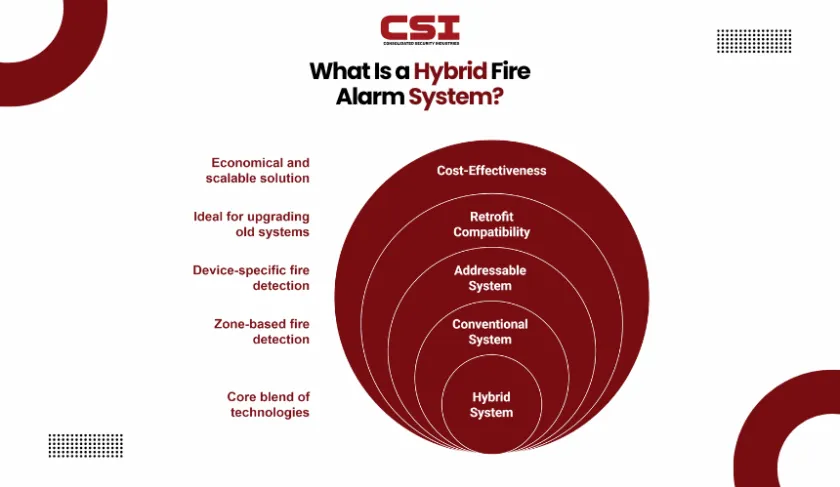
Hybrid fire alarm systems are advanced fire protection solutions that integrate both conventional and addressable technologies within a single architecture. Hybrid systems are flexible in terms of scalability, economical to retrofit, and have improved monitoring. They are made to fill in the gap between the old, zone-based systems and the new point-identification systems.
The systems are especially useful in buildings that are being renovated in phases, or mixed-use buildings, or in buildings with legacy infrastructure where full rewiring is not feasible.
Did you know: More than 1.3 million fires are reported annually in the United States, resulting in over 3,500 fatalities and billions of dollars in property damage. This underscores the urgent need for advanced fire detection and rapid response fire alarm systems. |
In this guide, we will explain what a hybrid fire alarm system is, detail its key components, highlight its operational advantages, and compare it directly with conventional fire alarm systems.
How Does a Hybrid Fire Alarm System Work?
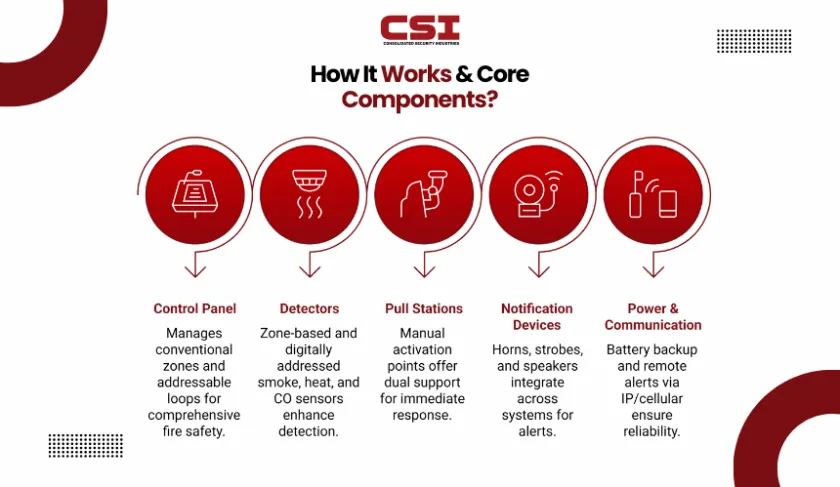
A hybrid fire alarm system is a mixture of both wired conventional circuits and wired addressable loops in the same control panel that may contain optional components of wireless fire alarm systems. This two-in-one design allows facilities to enjoy the cost-effectiveness of traditional circuits and the enhanced capabilities of addressable systems.
In contrast to conventional systems, which detect only the general area of fire or fault, hybrid systems make it possible to have selective addressability in specific areas.
For a better understanding, a hybrid panel can be used to accommodate the traditional smoke detectors on one floor and use addressable detectors with distinctive digital addresses on another floor, all within the same infrastructure.
These systems are NFPA 72 compliant, and can be customized to suit the unique needs of AHJs (Authorities Having Jurisdiction), and are therefore suitable to diverse fire safety applications in commercial, institutional, and industrial facilities.
What Components Make Up a Hybrid Fire Alarm System?
A hybrid fire alarm system incorporates elements from both conventional and addressable architectures. Its components are designed to work in tandem through a unified control panel that can process signals from both types of detection loops. Below are the core components typically found in a hybrid configuration:
1. Hybrid Fire Alarm Control Panel
The central processing unit can accommodate both conventional Initiating Device Circuits (IDCs) and addressable Signaling Line Circuits (SLCs). It decodes zone-level inputs of standard devices and individual signals of addressable devices, allowing real-time monitoring, event logging, and intelligent response.
2. Addressable Detectors and Modules
These are smoke detectors, heat detectors, and CO sensors, all having a unique digital address. They enable the precise location of the fire incident or fault in a secured zone. Third-party systems integration, e.g., HVAC shutdown or elevator recall, is also done using addressable input/output modules.
3. Conventional Detectors
These are non-addressable initiating devices, such as 2-wire or 4-wire smoke and heat detectors, which are normally wired in zones. They relay messages to the control panel that identify only the circuit (or zone) in which an alarm condition has been detected, but not a particular device.
4. Manual Pull Stations
Wall-mounted manual activation points (either conventional or addressable) enable the occupants of a building to manually activate the alarm system in the event of fire. In hybrid systems, the two types can exist together, based on the compatibility of circuits.
5. Notification Appliances
These are horns, strobes, speakers, and combination devices interconnected through Notification Appliance Circuits (NACs). When the system is in alarm state, it signals occupants by means of audio-visual alerting. Hybrid systems are able to facilitate synchronized notification in both types of detection.
6. Power Supply and Backup Batteries
UL-listed power supply units provide continuous operating current to both addressable and conventional devices. Sealed lead-acid batteries ensure system operation during power outages, meeting NFPA 72 backup power requirements.
7. Communication Modules
Interface modules or transceivers that support off-site monitoring via IP, cellular, or dial-up connections. These ensure that alarm and supervisory signals are transmitted to a central station or monitoring service, regardless of which subsystem (conventional or addressable) initiates the event.
What is the Difference Between Conventional and Hybrid Fire Alarm Systems?
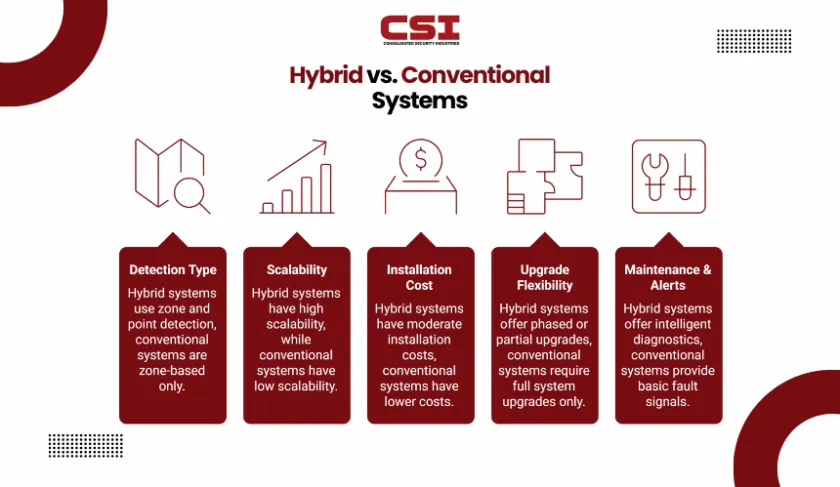
A conventional fire alarm system uses zone-based detection with limited scalability, while a hybrid system combines conventional and addressable technologies to offer both zone-level and device-specific detection with greater flexibility.
While both systems serve the same fundamental purpose, that is, detecting and alerting occupants of fire events, their design, scalability, and level of control vary significantly.
The comparison table below outlines the core differences between hybrid and conventional systems. The feature column identifies essential performance features. The hybrid fire alarm system column describes how these features function in a hybrid system, and the conventional fire alarm system column shows their behavior in a conventional system.
Feature | Hybrid Fire Alarm System | Conventional Fire Alarm System |
Detection Method | Zone + Addressable (Point Identification) | Zone-Based Only |
Scalability | Modular and Expandable | Limited to Zone Count |
Addressability | Partial to Full Addressing Supported | No Device-Level Identification |
Installation Flexibility | Supports both new wiring and existing infrastructure | Requires separate wiring for each zone |
Monitoring & Diagnostics | Advanced diagnostics per device | Basic fault detection per zone |
Code Compliance | Easier upgrades for NFPA 72 standards | Often requires full replacement to stay compliant |
Ideal Use Case | Retrofits, Expansions, Mixed-Use Facilities | Small, Single-Zone Buildings |
Cost Efficiency | Balanced initial investment with long-term savings | Lower upfront cost, but limited upgrade potential |
Hybrid systems offer significantly more flexibility and diagnostic control while preserving compatibility with existing conventional wiring. This makes them a preferred choice for facilities that need to scale or modernize without full infrastructure replacement.
Conventional systems operate on a simple idea: the control panel checks the current in every circuit. A change in current (caused by detector activation or manual call point use) triggers an alarm condition for that zone.
How Much Does a Hybrid Fire Alarm System Cost?
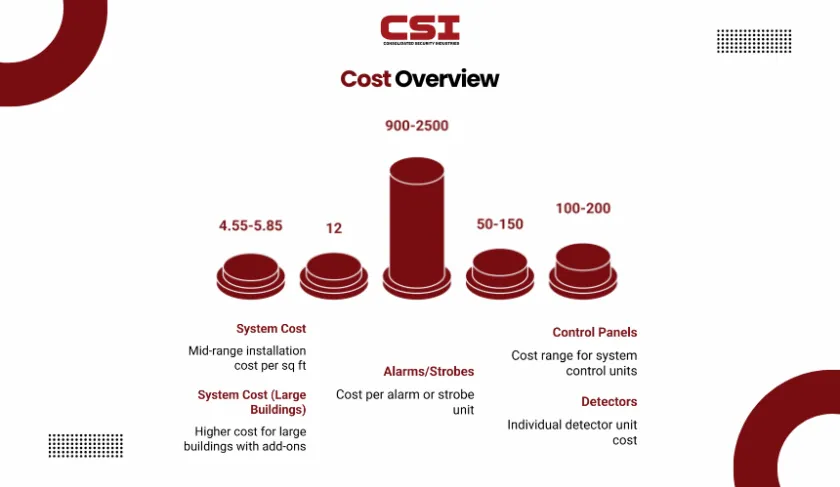
Understanding accurate cost estimates is crucial when evaluating a hybrid fire alarm system. Based on industry data, here’s a clear, up-to-date breakdown:
What is the Cost Per‑Square‑Foot?
- Hybrid fire alarm systems typically range from $4.55–$5.85 per sq ft, aligning with a mid-range solution that mixes conventional and addressable devices.
- For larger commercial installations, total installed costs may fall between $7–$12 per sq ft, similar to full addressable systems, due to added labor and components.
How Much Do the Components Cost?
- Entry-level to advanced Hybrid Control Panel costs $900–$2,500, depending on loop capacity and modules.
- Addressable detectors cost about $50–$150 each.
- Notification appliances: $100–$200 per horn‑strobe/speaker.
What Are Hybrid Fire Alarm Systems Best For?

Hybrid fire alarm systems are best suited for facilities that require advanced detection capabilities but also want to retain existing infrastructure. Below are the most common scenarios where hybrid systems provide maximum value:
- Buildings undergoing retrofits or phased renovations: Facilities where replacing all conventional wiring is impractical due to cost, structural limitations, or occupancy constraints.
- Mixed-use properties: Buildings combining commercial, residential, or industrial zones with differing fire protection needs, where addressability is only required in critical areas.
- Healthcare and educational institutions: Hospitals, clinics, and schools that need to maintain uninterrupted operations while incrementally upgrading legacy fire alarm systems.
- Historic or architecturally sensitive structures: Sites where invasive rewiring is restricted, and preservation of existing building materials is a requirement.
- Large multi-wing complexes: Facilities like corporate campuses or multi-building hotels that benefit from centralized control while retaining zone-based devices in less critical areas.
- Organizations managing budget-constrained compliance: Entities seeking to meet modern fire code requirements (e.g., NFPA 72) without fully overhauling existing systems in a single phase.
Hybrid fire alarm systems offer the flexibility to balance compliance, cost control, and technical scalability, making them an optimal choice for facility managers working within real-world constraints.
Frequently Asked Questions (FAQs)
Can hybrid systems use wireless detectors?
Yes. Hybrid systems can integrate wireless detectors via a translator or bridge module connected to the main control panel. In the U.S., these wireless components must fully comply with NFPA 72, the National Fire Alarm & Signaling Code.
When properly designed and installed using UL-listed wireless translators and detectors compatible with the hybrid panel, these systems are recognized as reliable and code-compliant alternatives under NFPA 72.
What are the main benefits of hybrid systems?
- Versatile design using existing infrastructure and intelligent loops.
- Cost-effective upgrades without full rewiring.
- Scalable architecture for future expansions.
- Meets both wired reliability and wireless flexibility.
What standards must hybrid fire alarms comply with?
In the U.S., systems must meet NFPA 72 requirements. Wireless hybrids in Europe must follow EN 54-25 for secure, bi-directional communication and battery backup.
How often should hybrid fire alarm systems be tested?
Hybrid fire alarm systems should undergo monthly visual and functional checks, including manual pull station tests and device communication verifications.
About 30% of commercial building fire alarm systems fail to operate properly, often due to aging components or dead batteries, highlighting the importance of regular maintenance, underscoring the need for consistent maintenance
In addition, annual full-system inspections by a certified fire alarm technician are required under NFPA 72 to ensure all detection, notification, and communication components function properly and remain code-compliant.
Can hybrid systems pinpoint the exact location of a fire?
Yes. Hybrid systems combine zone-level detection from conventional circuits and point-specific detection from addressable devices. This means alarms originating from addressable areas can be identified down to the individual detector, while alarms from conventional zones will still report the affected general area, enabling faster emergency response and maintenance targeting.
Do hybrid systems help reduce false alarms?
Yes. Hybrid systems that include analog-addressable detectors can continuously monitor changes in environmental conditions like smoke or heat levels. This allows the system to detect sensor drift, contamination, or sensitivity shifts, issuing a trouble signal before a false alarm occurs. This proactive feedback significantly reduces nuisance activations compared to conventional-only systems.