
- csi_security
What Is a Burglar Alarm? Purpose, Components, Function, and Types Explained
A burglar alarm, also known as an intrusion detection system, is a vital component of home security systems and commercial protection strategies. It is designed to detect unauthorized access to buildings or restricted areas. These systems act as both a proactive deterrent and a reactive alert mechanism against theft, break-ins, and other criminal activities.
Whether you are protecting residential homes, commercial properties, or industrial facilities, burglar alarms are tailored to provide real-time intrusion alerts, trigger audible sirens, and notify monitoring stations or property owners through various communication channels.
In the age of smart security solutions, burglar alarms have evolved from simple wired circuits into sophisticated, sensor-based detection systems that can integrate with video surveillance, mobile apps, and cloud-based monitoring platforms
Let’s explore how these systems work, their essential components, the different types available, and how burglar alarms integrate with modern security features.
What is a Burglar Alarm System
A burglary security system is an electronic intrusion detection solution designed to sense and respond to unauthorized access attempts.
Unlike broader security systems that may include fire detection or access control, a burglar alarm specifically focuses on preventing, detecting, and signaling break-ins, forced entries, or unauthorized movements within a secured zone.
At its core, a burglar alarm monitors entry points, such as doors and windows, and uses a network of electronic sensors, including motion detectors, magnetic contacts, and glass-break detectors, to detect suspicious activity.
These sensors are linked to a control panel, which processes signals and determines whether to trigger an alert protocol, such as activating a siren, strobe light, or notifying a remote monitoring station.
Five key features commonly associated with a burglar alarm include:
- Perimeter breach detection
- Tamper-resistant enclosures
- Fail-safe power backup systems
- Zone-based monitoring configurations
- Event-logging and reporting mechanisms
Purpose of a Burglar Alarm

The primary function of a burglar alarm system is to protect life, property, and assets by detecting and responding to unauthorized intrusions.
These systems are engineered to not only identify security breaches in real time but also act as strong psychological and physical deterrents against potential criminal activity. Below are four key purposes served by a modern burglar alarm system:
Protecting Property and Assets
At its core, a burglar alarm safeguards physical assets, inventory, and valuable personal belongings. The system ensures early detection of forced entry or tampering by continuously monitoring vulnerable points, such as doors, windows, and perimeter zones.
In commercial settings, this helps prevent inventory loss and equipment theft; in homes, it protects family possessions and sentimental valuables.
Deterring Criminal Activity
The mere presence of a visible alarm system, especially when combined with exterior sirens, warning decals, or motion-triggered lights, acts as a powerful deterrent.
Did you know? A 2013 offender survey across three US states discovered that 83% of burglars check for alarms before choosing a target, and about 73% said they would avoid homes once they detected a security system. |
Audible alarms immediately disrupt the intruder’s intent and increase the likelihood of them fleeing before committing a crime.
Triggering Emergency Response
Burglar alarms are often linked to central monitoring stations or mobile alert platforms. When a system detects a verified intrusion, it can instantly trigger an automated response protocol, which may include:
- Notifying the property owner via SMS or app alert
- Sending a signal to a 24/7 monitoring service provider
- Dispatching law enforcement or security personnel
This fast reaction time enhances the chances of preventing the theft or apprehending the intruder.
Providing Peace of Mind
Whether the property is occupied or vacant, a burglar alarm provides constant security assurance.
Business owners, homeowners, and property managers can monitor and control the system remotely, verify events through integrated security cameras, and receive real-time updates. This increases confidence that their assets are protected around the clock.
What are The Key Components of a Burglar Alarm System?
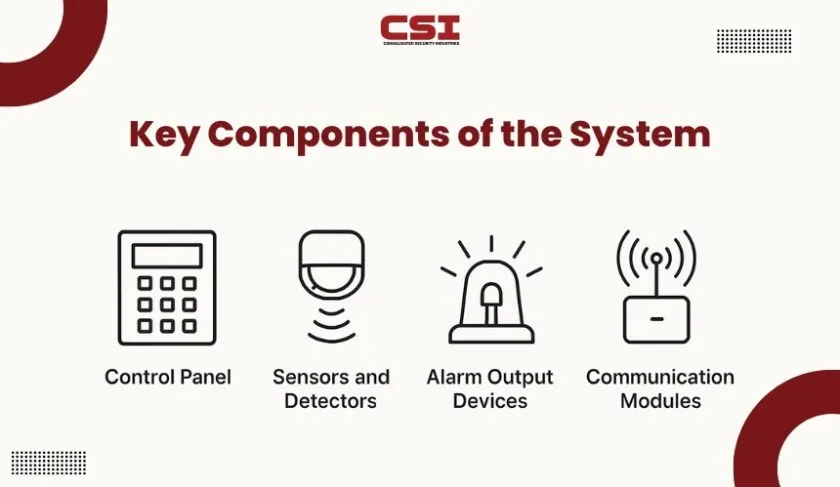
A burglar alarm system operates as an integrated network of electronic devices that work in harmony to detect, evaluate, and respond to intrusion events.
Each component plays a specific role in ensuring system integrity, threat identification, and signal communication.
Understanding these components helps in designing a system tailored to specific property requirements, whether residential, commercial, or industrial.
Here are the five essential components of a modern burglar alarm system:
1. Control Panel (The System Brain)
The control panel is the central processing unit that connects, powers, and manages all input/output devices in the alarm system.
It interprets sensor data, manages arming/disarming logic, and activates alert protocols when a breach is detected.
Key functions of the control panel:
- Stores user codes and alarm history logs
- Divides the property into configurable zones
- Communicates with monitoring centers or mobile apps
- Enables tamper alerts and fail-safe lockdown protocols
2. Sensors and Detectors
These devices are responsible for identifying the physical indicators of intrusion, such as movement, vibration, or entry through protected openings. Each type of sensor is designed to detect specific threats.
- Door and Window Contact Sensors: Mounted at entry points, these use magnetic reed switches to detect when a door or window is opened unexpectedly while the system is armed
- Passive Infrared (PIR) Motion Detectors: Detects human body heat and movement in a protected area. Ideal for monitoring large interior spaces.
- Glass Break Detectors: Recognize the sound frequency or shock vibration of breaking glass, providing added coverage for windows and glass doors.
- Vibration and Shock Sensors: Installed on walls, safes, or structures; these detect impact forces or drilling attempts, often used in commercial settings.
3. Alarm Output Devices
When a verified threat is detected, the alarm system triggers audible and visual alert mechanisms to deter the intruder and notify occupants or neighbors.
Common Output devices:
- Indoor and outdoor sirens (often >100 dB)
- Strobe lights for visual identification of an active alarm
- Voice annunciators or pre-recorded warnings in smart systems
4. Communication Modules
These components transmit alarm signals from the control panel to external entities like monitoring stations or user devices. Reliable communication is vital for real-time alert delivery.
Common transmission methods:
- Cellular (GSM/LTE) – Secure and independent of local infrastructure
- Wi-Fi/IP – Fast and flexible, often with app integration
- Landline (POTS) – Traditional but increasingly obsolete
Redundancy is often built in to ensure message delivery during outages.
5. Backup Power Supply
Power disruptions are a common tactic during burglaries. A battery backup system ensures that the alarm system continues operating during grid failures or sabotage attempts.
Key features of a backup power supply:
- Rechargeable sealed lead-acid or lithium batteries
- 12–24 hours of standby power on average
- Battery health monitoring in advanced systems
How Does a Burglar Alarm Work?
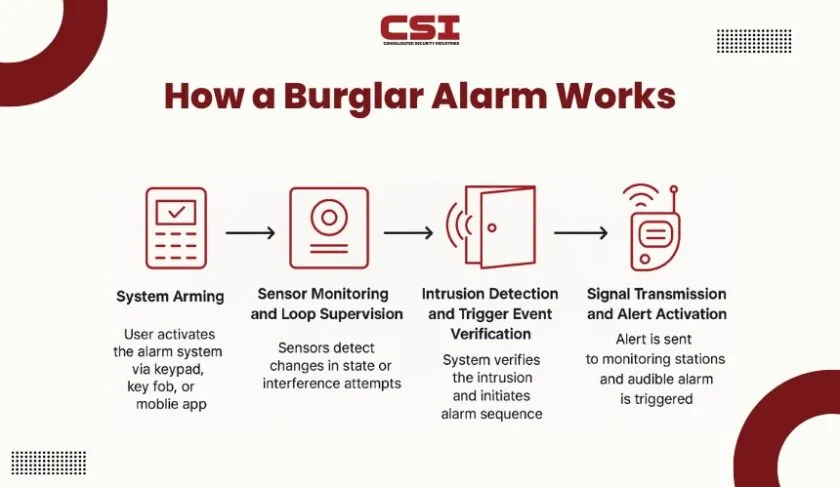
A burglar alarm operates through a systematic chain of electronic interactions, starting from system arming to breach detection, followed by signal transmission and alert activation.
This sequence ensures that any unauthorized access attempt is quickly identified and acted upon, either locally through sirens or remotely via monitoring centers and mobile notifications.
Here’s a step-by-step breakdown of how a burglar alarm system works:
1. System Arming
The process begins when the user activates the alarm system, either manually via a keypad, key fob, mobile app, or through scheduled automation. Depending on the configuration, the system may be armed in:
- Stay mode (perimeter protection while occupants are inside)
- Away mode (full interior and perimeter coverage)
- Night mode (custom zone activation for sleep hours)
2. Sensor Monitoring and Loop Supervision
Once armed, the system enters a live monitoring state, where all connected sensors, door contacts, motion detectors, and glass-break sensors are constantly polled.
The system checks for a change in state, such as a closed magnetic loop becoming open, which signals a potential intrusion.
Advanced systems also perform:
- Heartbeat checks to confirm sensor connectivity
- Tamper circuit verification to detect interference attempts
3. Intrusion Detection and Trigger Event Verification
When a sensor detects an anomaly (e.g., door opened, motion detected), the system instantly evaluates whether the event matches a predefined threat pattern.
Some systems incorporate dual-trigger logic or entry delays to reduce false alarms, especially in professionally monitored environments.
- If a threat is confirmed, the control panel initiates an alert protocol.
- If the system is disarmed within the entry delay, the event is logged but no alert is sent.
4. Signal Transmission
Upon detecting a confirmed intrusion, the system transmits an alert through its configured communication channels. These may include:
- GSM/LTE modules for cellular alerts
- Wi-Fi/IP modules for cloud-based mobile notifications
- Contact ID format for central station transmission
Modern systems may also send push notifications, email alerts, or in-app messages to designated users.
5. Alert Activation and Response
Simultaneously, the system triggers its output devices, such as internal sirens, external strobe lights, or voice annunciators, to draw attention and scare off intruders.
In monitored systems, the central station evaluates the signal and may dispatch law enforcement or private security based on the incident type.
- Local systems rely solely on deterrent noise and visual cues
- Monitored systems follow SIA (Security Industry Association) response protocols
Types of Burglar Alarms
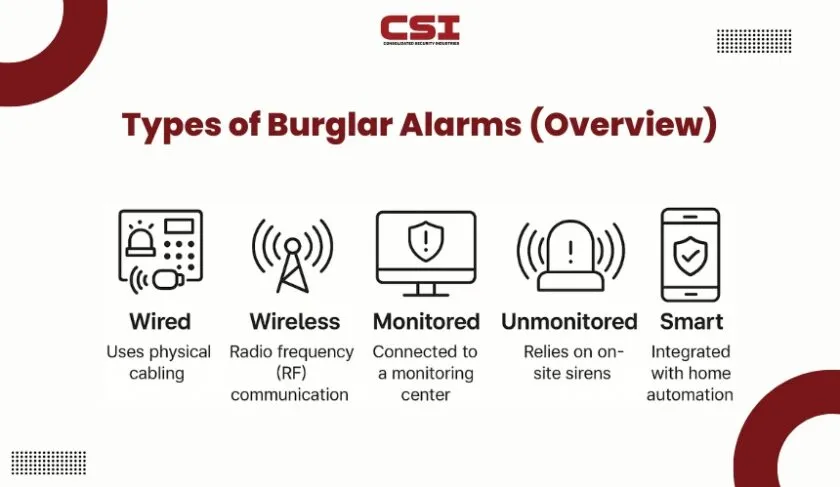
Burglar alarms come in a range of configurations tailored to the size, usage, and security demands of a property. From traditional wired systems to cloud-connected smart alarms, each type of burglar alarm serves specific operational needs and integration capabilities.
Understanding these classifications is essential when selecting a system that matches your security goals, monitoring preferences, and installation environment.
1. Wired Burglar Alarms
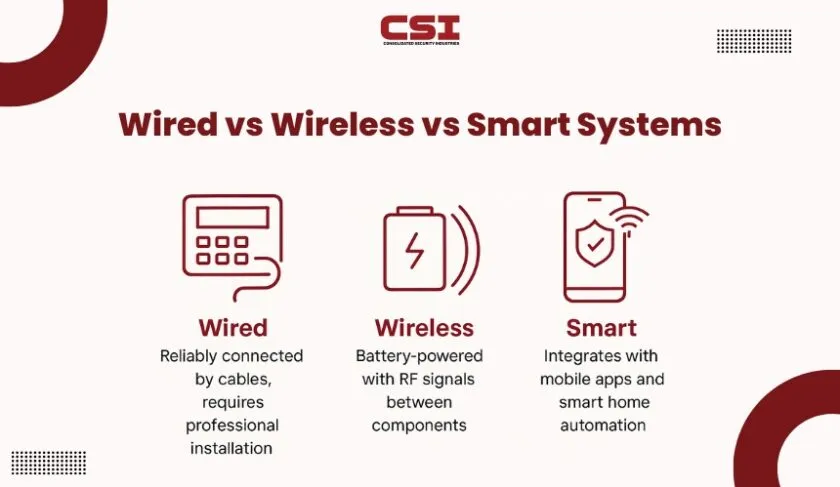
A wired home security system uses physical cabling to connect all sensors, control panels, and alert devices. These systems are typically more reliable in signal transmission and less prone to wireless interference.
What are wired burglar alarms best for?
- Large homes, commercial facilities, and high-security sites
- Permanent installations where wiring is feasible during construction or renovation
What are the key benefits of wired burglar alarms?
- Stable and interference-free communication
- No reliance on battery-powered sensors
- Long lifespan with minimal signal latency
2. Wireless Burglar Alarms
Wireless burglar alarms use radio frequency (RF) communication to connect sensors and devices without physical cables. These systems are easier to install and more flexible, especially in existing buildings.
Where are wireless systems ideal to be used?
- Homes, small offices, rental properties
- DIY installations or properties with aesthetic constraints
What are the key advantages of wireless burglar alarms?
- Fast, non-invasive installation
- Easily expandable with new sensors or smart home devices
- Battery-powered, often with tamper alerts
3. Monitored Burglar Alarms
These alarms are connected to a professional monitoring center that oversees the system 24/7. When triggered, the system sends a signal to the monitoring provider, who verifies the alert and dispatches law enforcement or private security if necessary.
What are monitored burglar alarms best for?
- High-value assets, remote properties, or businesses with regulatory compliance needs
- Users requiring a guaranteed emergency response
What are the key benefits of monitored burglar alarms?
- Immediate threat escalation
- Alarm verification reduces false dispatches
- Integration with fire protection, medical, and environmental monitoring devices
4. Unmonitored Burglar Alarms
These systems rely on on-site sirens and strobes to deter intruders, also called local alarms. They do not connect to a monitoring service, making them more affordable but less responsive in emergencies.
Who should use an unmonitored burglar alarm?
- Budget-conscious users
- Occupied homes or properties in low-risk areas
What are the key beneficial features of unmonitored burglar alarms?
- No monthly monitoring fees
- Immediate audible deterrent
- Works independently of third-party services
5. Smart Burglar Alarms
Smart alarms integrate with home automation platforms, allowing users to monitor and control their security systems via smartphones, tablets, or cloud-based dashboards.
These systems often feature AI-powered analytics, geofencing, and real-time push notifications for smart home automation.
Who should consider a smart burglar alarm system?
- Tech-savvy homeowners and smart home enthusiasts
- Smart home environments with integrated IoT devices
What key benefits do smart burglar alarms offer over other types?
- Remote arming/disarming
- Live system status and sensor history
- Integration with video surveillance, lighting, and locks
6. Hybrid Burglar Alarms
Hybrid systems combine wired and wireless technologies, offering the reliability of wired communication with the flexibility of wireless sensors. This is ideal for properties that require segmented upgrades or have partial pre-existing infrastructure.
What are Hybrid burglar alarms best for?
- Retrofitting older systems
- Multi-building properties or expansions
What are the main advantages of hybrid burglar alarms?
- Modular architecture
- Customized zone deployment
- Transition-friendly for future upgrades
Integration of Burglar Alarms with Modern Security Systems
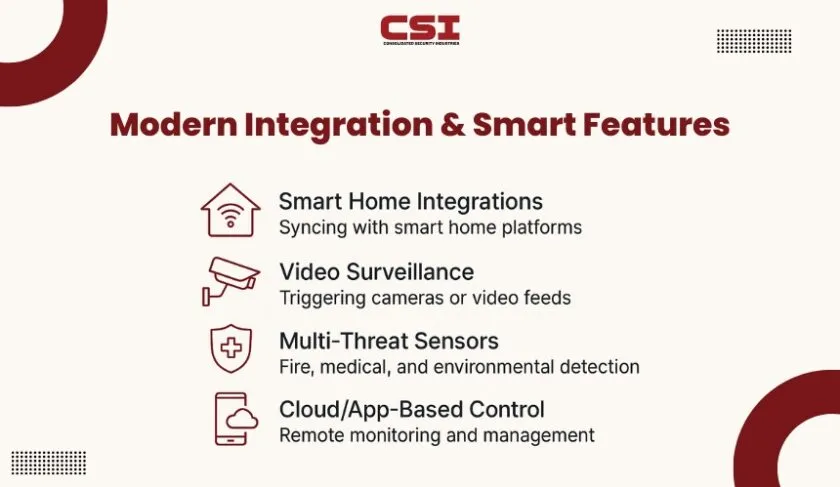
Modern burglar alarms often feature wireless communication modules, smartphone integrations, and AI-based detection algorithms, enabling real-time notifications and remote management.
Whether installed in a small home or a multi-level commercial facility, these systems serve as a critical layer of defense in any property’s security strategy. CSI Security specializes in integrating burglar alarms with broader smart devices ecosystems.
- Smart Home Integration: Burglar alarms can sync with smart hubs (e.g., Alexa, Google Home, Apple HomeKit) to enable voice commands, geofencing, and automated routines, like locking doors or turning on lights when the system is armed.
- Video Surveillance Connectivity: Integrated with CCTV or Wi-fi camera systems, alarms can trigger video recording on event detection, send live camera feeds to mobile devices, and improve threat verification through visual confirmation.
- Fire, Medical, and Environmental Sensors: Many hybrid systems combine burglary detection with smoke detectors, carbon monoxide detection sensors, flood alerts, and panic buttons, delivering multi-threat protection in one unified platform.
- Cloud and App-Based Control: Users can manage the entire security setup remotely through cloud dashboards or mobile apps, receiving real-time alerts, accessing event logs, and customizing system behaviors from anywhere.
Frequently Asked Questions (FAQs)
Why do burglar alarms often trigger false alerts, and how can I reduce them?
False alarms are extremely common; studies show that more than 90% burglar alarm alerts are false. Common triggers include pets, weak batteries, or unsecured doors and windows.
To reduce false alarms, install pet-immune motion sensors, secure all entry points properly, maintain healthy battery levels, and use dual-trigger logic or entry delays.
Can I operate a burglar alarm without a landline or internet connection?
Yes, modern systems often include cellular GSM/LTE modules or SIM-enabled monitoring, which send alerts even if the landline or Wi‑Fi fails.
For complete reliability, opt for dual-path communication (cellular + Wi‑Fi) to ensure signal transmission during power outages or cut lines.
Will my dog or cat ring the alarm?
Not necessarily. Many current burglar alarms feature pet-friendly motion detectors, which ignore animals below a certain size, using heat or weight thresholds. Alternatively, you can exclude pet-accessible areas or rely on door/window sensors in rooms where pets roam freely.
Do I need a certified alarm installer or a site survey?
Yes. Certified installation (e.g., NSI or SSAIB accredited in the UK) ensures regulatory compliance and insurance validity.
A properly working alarm system requires professional installation. A site survey positions sensors and cameras optimally, integrates the system with smart-home components, and minimizes technical issues, especially important for fire-code or monitored systems.