
- csi_security
Burglar Alarms vs. General Security Systems | Which One Is Best For You?
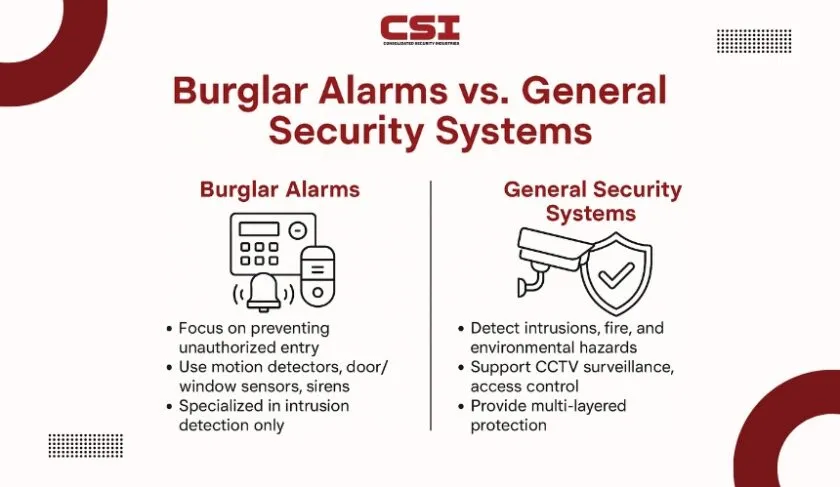
At first glance, burglar alarms and general security systems may seem interchangeable. After all, both are designed to protect your property from threats. However, their functionality, component integration, and scope of protection differ significantly.
A burglar alarm is a specialized intrusion detection system. It focuses exclusively on preventing unauthorized entry, using devices like motion detectors, door/window sensors, and sirens.
In contrast, a general security alarm system refers to a comprehensive, multi-layered platform that not only detects intrusions but also supports security camera surveillance (CCTV), fire and smoke detection, access control, environmental monitoring, and smart home automation.
Did you know: According to the FBI’s latest Uniform Crime Reporting (UCR) data, there were over 800k burglaries reported in the United States in 2022, with residential properties accounting for 62% of these incidents. |
This guide breaks down both systems, compares their architecture and capabilities, and helps you identify which solution aligns best with your security requirements.
What Are Burglar Alarm Systems?
A burglar alarm system is a targeted intrusion detection solution designed to detect unauthorized access to a property’s entry points, such as doors, windows, or other vulnerable access areas.
These systems act as the first line of defense against break-ins by using sensor-based detection and immediate audio or remote alerts to notify occupants or monitoring centers.
What is the Main Purpose of a Burglar Alarm System?
The core purpose of a burglar alarm is to detect a potential intrusion the moment it occurs. It operates using a network of perimeter and motion-based sensors, which trigger a local alarm (sirens or flashing lights) or send an alert to a central monitoring station or the user’s mobile device.
When a sensor is breached, whether it’s a door contact opening or motion detected in an armed zone, the system activates the alarm protocol to deter intruders and alert responsible parties in real time.
Key Components of a Burglar Alarm System
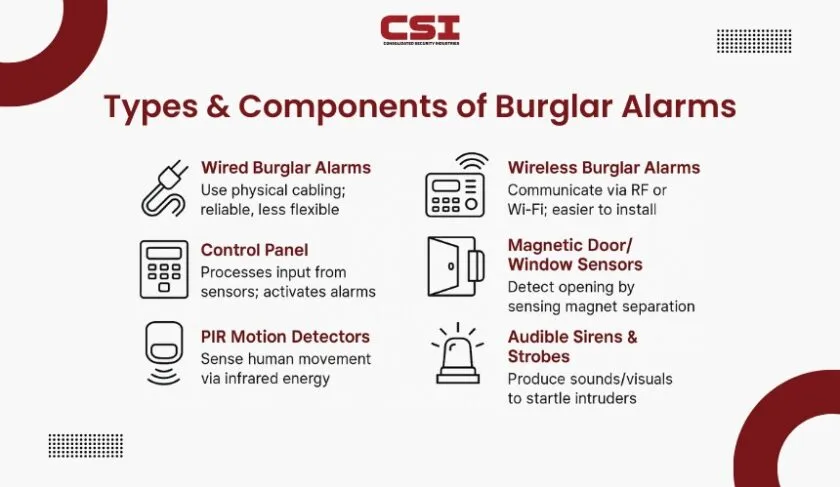
- Control Panel: Acts as the system’s brain, processing input from sensors and activating alarms or alerts based on programmed logic.
- Magnetic Door and Window Sensors: These sensors detect the opening of doors or windows by sensing the separation of two magnetic contact points.
- PIR Motion Detectors: Passive Infrared (PIR) sensors detect changes in infrared energy caused by human movement within a protected space.
- Glass Break Sensors: These devices identify the specific sound frequency of breaking glass and activate when a window or glass door is shattered.
- Audible Sirens and Strobe Lights: Once triggered, these components produce loud sounds and visual warnings to startle intruders and alert occupants or neighbors.
- Remote Keypads or Mobile App Integration: For arming/disarming the system and real-time status monitoring.
How Many Types of Burglar Alarms Are Available?
Burglar alarms are classified based on how they communicate, how they respond to intrusions, and whether they are connected to a professional monitoring service. The four main types of burglar alarm systems are defined below:
- Wired Burglar Alarms: Use physical cabling to connect all components. Known for reliability but require professional installation and are less flexible for upgrades.
- Wireless Burglar Alarms: Communicate via RF or Wi-Fi signals. Easier to install, more scalable, and increasingly common in residential and small office environments.
- Monitored Burglar Alarms: Linked to a 24/7 professional monitoring center. When an alarm is triggered, the monitoring team verifies the event and dispatches emergency responders if necessary.
- Unmonitored Burglar Alarms (Audible-Only Systems): Trigger local sirens or strobe lights without contacting a central station. Relies on neighbors or occupants responding to the alert.
Where Burglar Alarms Are Most Effective?
Burglar alarm systems are particularly effective in:
- Single-family homes
- Apartments and condos
- Retail storefronts
- Small offices and storage units
- Perimeter-only applications with low fire or environmental risk
They are ideal when the primary concern is unauthorized entry, not full-scale security integration involving fire alarms, video surveillance, or access control systems.
What Is a General Security System?
A general security system refers to a multi-functional platform designed to protect people and property from a wide range of threats, including burglary, fire, unauthorized access, and environmental hazards.
Unlike burglar alarms, which focus solely on intrusion detection, general security systems provide integrated protection across physical, environmental, and digital layers of a building or premises.
These systems combine hardware components like sensors, cameras, access panels, and sirens with software platforms that enable centralized control, remote access, and automated response actions.
They are designed to scale with property size and risk level, making them suitable for both residential and commercial use.
Integrated Technologies in a General Security System
A general commercial and home security system can be equipped with modern technologies. A fully equipped general security system may include one or more of the following six technologies:
- CCTV Surveillance Cameras: Provide real-time and recorded video monitoring of indoor and outdoor areas. May include AI-powered analytics for motion detection, facial recognition, or license plate capture.
- Access Control Systems: Restrict entry to sensitive areas using key cards, PINs, biometrics, or mobile credentials. Track and log entry/exit events for security audits.
- Intrusion Detection Systems: Incorporate door/window sensors, motion detectors, and glass break detectors. These work similarly to burglar alarms but are integrated into a broader ecosystem.
- Fire Alarm Systems: Include smoke detectors, heat sensors, manual pull stations, and strobes/horns. Can be conventional, addressable, or wireless depending on the building layout and code requirements.
- Environmental Hazard Sensors: Detect threats such as carbon monoxide, natural gas leaks, flooding, extreme temperature shifts, or humidity that could damage property or threaten safety.
- Smart Automation & Remote Access: Integrate with mobile apps and cloud platforms to allow remote system arming/disarming, live camera viewing, and alert management.
- Smart Home Devices Integration: Allows the system to connect with smart home systems, including voice assistants, lighting, locks, and thermostats. This enhances automation and remote control using platforms like Alexa, Google Assistant, Google Home App, or Apple HomeKit.
Interesting Information: Over 70% customers preferer security systems that include smart home integration, such as remote arming/disarming, live video feeds, and automation features (e.g., lights, locks, thermostats). |
Alarm System Types Found Within General Security Systems
A general security system may include multiple alarm subsystems to provide layered protection. Common alarm types are:
- Fire Alarm Systems: Used to detect and respond to smoke, heat, or flame. Includes conventional, addressable, and wireless types, often mandated by building codes.
- Intrusion Alarm Systems: Focused on detecting unauthorized access, using motion sensors, door contacts, and sirens, similar to standalone burglar alarms but with centralized integration.
- Access Control Alarm Systems: Trigger alerts when access attempts are denied or doors are held open. Especially critical in commercial or high-security environments.
- Hybrid Alarm Systems: Combine fire, intrusion, access control, and automation in a unified platform. Ideal for large buildings or mixed-use facilities needing centralized control.
Where Are General Security Systems Most Effective?
General security systems are designed for broad threat coverage and centralized system management. They are best suited for:
- Office complexes and corporate campuses
- Warehouses and logistics centers
- Retail chains and multi-site operations
- Educational institutions and healthcare facilities
- High-end residential properties with smart home technology
These systems are essential for users who need multi-zone protection, automated notifications, audit trails, and professional monitoring, all within a single platform.
Key Differences Between Burglar Alarms and General/Smart Security Systems
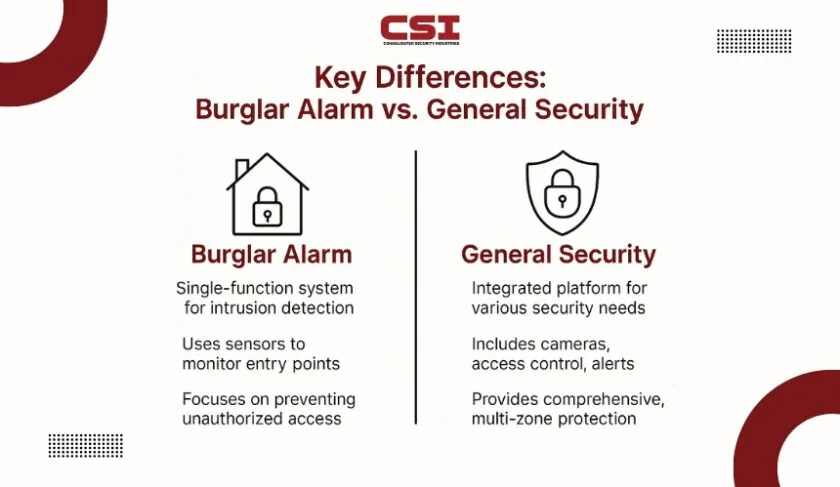
Burglar alarms and general security systems are mainly designed for your security and your family members, but they differ significantly in architecture, purpose, and capability. A burglar alarm is a single-function system designed solely for detecting unauthorized entry.
In contrast, a general security system is a multi-functional, integrated platform that encompasses intrusion detection, video surveillance, access control, fire monitoring, and remote management, all working together in a centralized ecosystem.
The table below outlines the core differences between burglar alarms and general security systems across key technical and functional criteria.
Each row compares a specific feature, with the left column describing how it applies to burglar alarms, and the right column detailing how it applies to general security systems.
Feature | Burglar Alarm System | General Security System |
Primary Purpose | Detect and deter intrusions at entry points (doors/windows) | Provide comprehensive protection against intrusion, fire, environmental threats, and access violations |
System Scope | Single-layer intrusion alert system | Multi-layer integrated security solution |
Sensor Coverage | Entry point sensors, motion detectors, glass break sensors | Includes intrusion sensors + smoke detectors, CO sensors, temperature sensors, etc. |
Component Integration | Operates as a standalone system or with basic mobile app | Centrally integrated system with CCTV, access control, automation, and remote command |
Monitoring Options | Typically unmonitored or third-party monitored | Commonly includes 24/7 professional monitoring and event-based mobile alerts |
Scalability | Limited scalability; ideal for small-scale environments | Highly scalable to cover large commercial, industrial, or multi-zone properties |
Automation Capabilities | Usually lacks automation | Supports smart automation—lights, locks, HVAC, schedules, and conditional triggers |
Data Logging & Reporting | Minimal or none | Event logging, access audit trails, real-time dashboards |
Installation Complexity | Simple installation; often DIY-friendly | Requires professional configuration, network integration, and long-term system planning |
Typical Use Case | Residential homes, small offices, isolated storage units | Enterprises, mixed-use buildings, schools, hospitals, high-end residential, multi-site operations |
In summary, burglar alarms offer focused intrusion protection, while general security systems deliver comprehensive, scalable, and integrated building-wide safety solutions.
Which One Is Right for You? Use Case-Based Recommendations
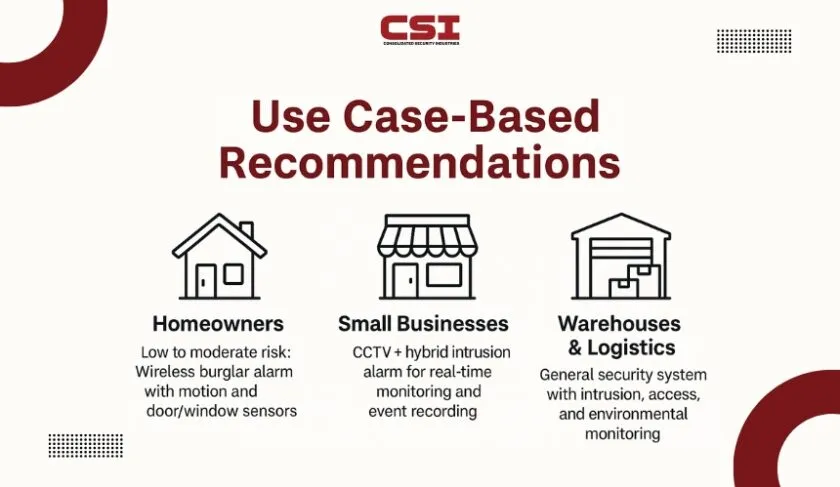
Choosing between a burglar alarm system and a general security system depends on several critical variables: property type, threat exposure, compliance needs, budget, and future scalability.
This section breaks down real-world use cases to help you select the most appropriate solution based on specific needs, rather than assumptions or general advice.
1. Residential Homeowners (Low to Moderate Risk)
If you live in a single-family home or an apartment in a low-crime area, and your primary concern is break-ins during off-hours or vacations, a wireless burglar alarm may be sufficient.
Choose a system that includes motion detectors, door/window sensors, and a mobile app for remote arming/disarming.
- Recommended System: Self-monitored security system, wireless burglar alarm with optional smartphone alerts.
- Add-ons: Video doorbell, backup battery, and cellular failover module.
2. Small Business Owners & Retail Shops
For storefronts, salons, and boutique retail, where after-hours intrusion and internal theft are key concerns, a general security system with basic intrusion detection + video surveillance is ideal.
This allows for real-time monitoring, event recording, and the ability to review footage in case of suspicious activity.
- Recommended System: Hybrid intrusion alarm + CCTV system with mobile access and basic logging.
- Add-ons: Panic button under the counter, restricted area door sensors, cloud storage for video footage.
3. Warehouse Managers & Logistics Operators
In high-risk environments such as distribution centers or storage facilities, asset protection must go beyond intrusion detection. These properties benefit from multi-zone general security systems that combine intrusion detection, access control, and environmental hazard sensors (e.g., temperature, CO, flood).
- Recommended System: General security system with layered zones, badge-based access, and environmental monitoring.
- Add-ons: Fire alarm integration, audit logging, remote dashboard, and mobile alerts.
4. Multi-Tenant Residential or Commercial Properties
If you manage an apartment complex, office building, or mixed-use facility, a fully integrated security system with central control, video intercoms, smart locks, and professional monitoring is essential.
The ability to log, restrict, and report access events improves both safety and regulatory compliance.
- Recommended System: General security system with remote access control and video intercom.
- Add-ons: Emergency evacuation interface, building-wide fire alarm, and secure entry vestibules.
5. When in Doubt, Choose Scalable Architecture
If your long-term plan includes property expansion, added users, or upgraded risk controls, start with a general security system. It offers the flexibility to evolve without requiring a full system replacement.
Modern Trends in Security Systems
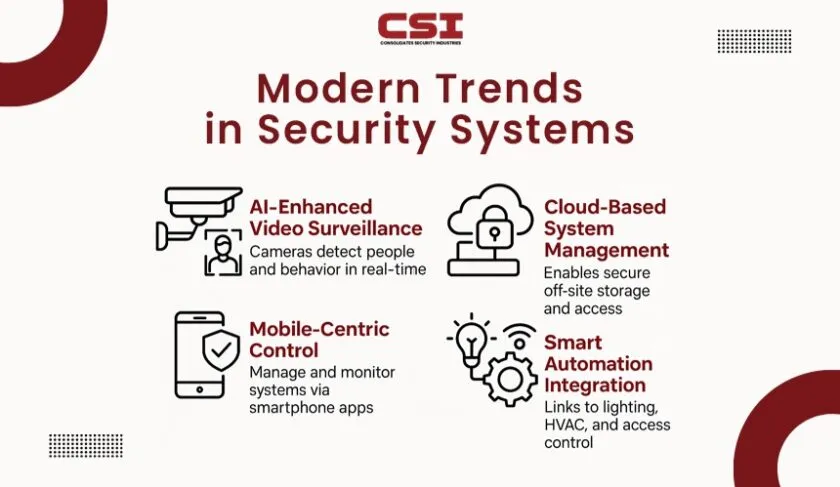
Today’s security systems are not just reactive; they are proactive, intelligent, and deeply connected. Advancements in AI, cloud infrastructure, and mobile integration have redefined what users expect from both residential and commercial setups.
Here’s a look at the top features driving modern security system upgrades:
- AI-Enhanced Video Surveillance: Cameras now detect people, vehicles, and suspicious behavior with real-time analytics, reducing false alarms and enabling smart search playback.
- Cloud-Based System Management: Events, alerts, and video footage are stored off-site for secure access from anywhere, while system health checks and updates happen automatically.
- Mobile-Centric Control: From smartphones, users can arm/disarm systems, view live footage, manage zones, and receive instant push alerts for real-time decision-making.
- Smart Automation Integration: Security systems now link with lighting, HVAC, and access controls, triggering custom actions like locking doors or turning on lights when motion is detected.
- Built-In Compliance Readiness: Enterprise-grade systems are now built to support fire code requirements, access event logging, and secure data retention for industries under regulation.
As these technologies continue to converge, security systems are becoming more intelligent, flexible, and future-ready. CSI Security provides integrated security solutions with top security systems, designed with precision, compliance, and long-term reliability in mind.
Frequently Asked Questions (FAQs)
How reliable are wireless alarm systems against signal jamming?
Modern wireless systems use frequency-hopping and encrypted two-way communication, which makes jamming difficult. However, determined intruders may attempt signal interference.
Mitigation tips:
- Use alarm panels with anti-jamming alerts and cellular backup.
- Combine wireless sensors with hardwired communication for critical zones to ensure redundancy.
Can a burglar alarm trigger a silent alert instead of a siren?
Will pets set off motion detectors?
Most modern systems include pet-immune PIR sensors calibrated to ignore animals under a specified weight (typically 40–80 lb). Adjusting sensor sensitivity and strategic placement minimizes false alarms when pets are present.
What backup options are there for power or internet outages?
Alarm systems typically include internal backup batteries that sustain operation during power loss. For connectivity continuity, adding a cellular/LTE fallback ensures the system remains in contact with monitoring centers even if the wired system, internet, or phone lines fail.